
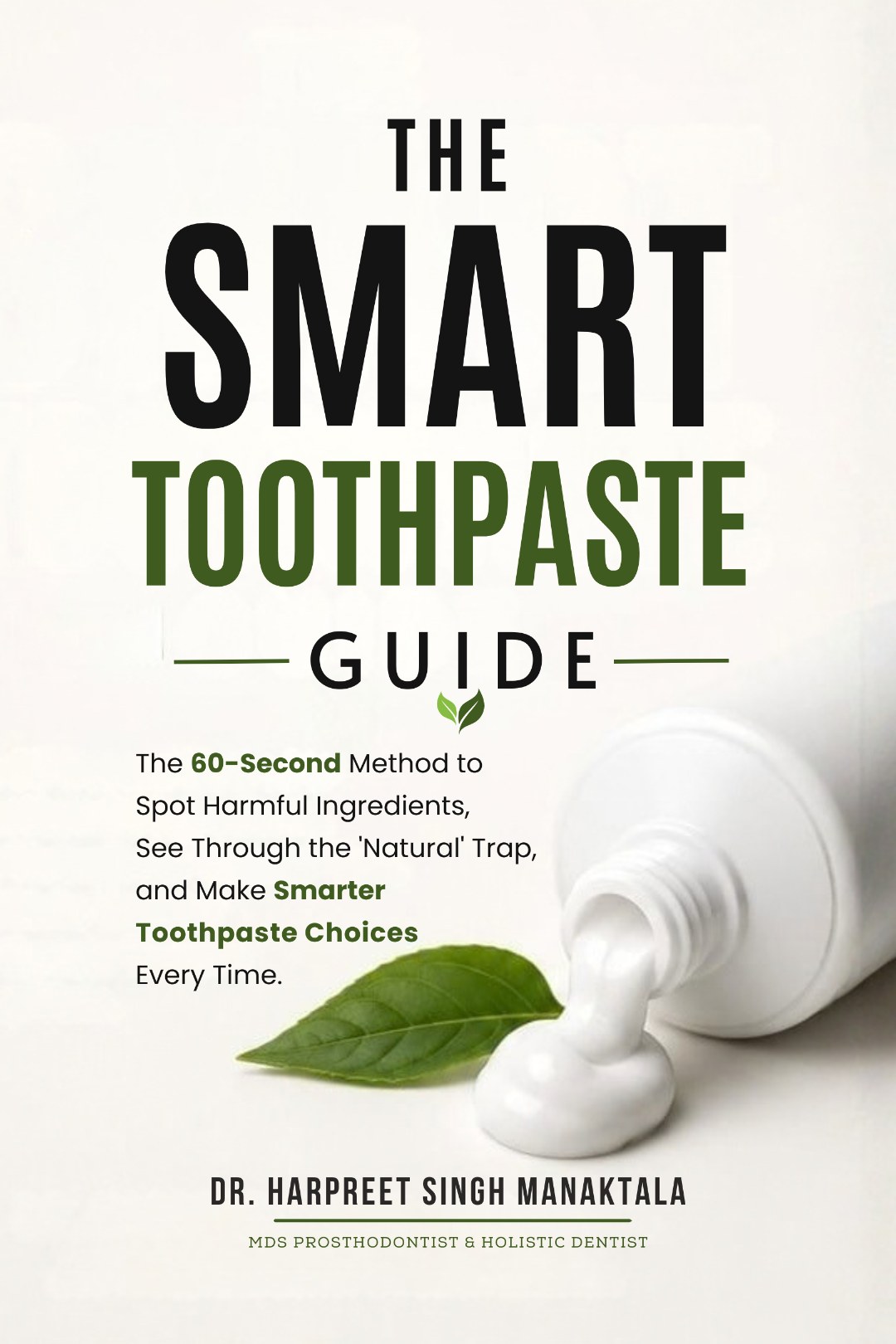
The Smart Toothpaste Guide
You use it twice a day. You have no idea what is in it.
Neither does almost anyone else.
The front of your toothpaste tube is designed to sell. The claims are carefully chosen. The packaging is reassuring. The word “natural” appears on a brown box surrounded by leaves.
None of that tells you what is actually inside.
The Smart Toothpaste Guide gives you a 60-second method to turn the tube around, read what is actually on the label, and know exactly what you are choosing to put in your mouth and your family’s mouths every single day.
Written by a practising prosthodontist. Built for anyone without a chemistry degree. Referenced against 27 peer-reviewed sources.
10
Chapters in plain language
60 sec
To check any label
27
Peer-reviewed sources
3
Bonus reference sections
The Problem Is Not the Toothpaste. It Is the Label.
Most people choose toothpaste the same way.
They pick up the box. They read the front. Whitening. Fresh breath. Complete protection. Herbal. Natural. SLS-free. Enamel care.
The claims sound good. The packaging looks clean. The price is fine. Into the basket it goes.
But the front of the tube has one job: to get your attention and earn your trust. It is not required to tell you everything that is inside.
The back of the tube is where the real story lives.
And most people never read it. Not because they do not care, but because it looks like a chemistry exam they never studied for.
Sodium lauryl sulphate. Polyethylene glycol. Cocamidopropyl betaine. Carrageenan. CI 42090.
What does any of that mean? What is it doing in your mouth?
The Smart Toothpaste Guide answers every one of those questions. Then it gives you a system so simple you can use it standing in the shop in 60 seconds.
One System. Three Colours. 60 Seconds.
The Traffic Light and Scorecard is the heart of this guide.
Red.Ingredients the author prefers to avoid, with the specific reason behind every flag.
Yellow.Ingredients that need a closer look. The answer depends on the formula, the amount, or your own mouth.
Green.Ingredients that are genuinely good to see, either for your teeth or for a clean, simple formula.
The score starts at 100. Each Red ingredient you find costs 10 points.
That is it.
You do not need a chemistry background. You do not need to memorise anything. You need three colours and five names to start with, and the guide walks you through all of them.
The Fast Five every label reader needs to know
- 1.Sodium lauryl sulphate (SLS) and SLES.
- 2.Polyethylene glycol (PEG) and related ingredients.
- 3.Artificial sweeteners.
- 4.Artificial colours.
- 5.Triclosan.
Learn these five. You already know more than most people who buy toothpaste every week.
What the Guide Covers
The full investigation, in plain language.
How toothpaste actually works.
What the five main ingredient groups do: the abrasives that clean, the humectants that keep the paste soft, the foaming agents that make the bubbles, the flavours and colours that make it taste and look appealing, and the active ingredients that actually protect your teeth. Most people have no idea which is which. After this section, you will.
Why foam has nothing to do with clean.
Foam makes brushing feel impressive. It does not make your teeth cleaner. The guide explains exactly what creates the foam, why more foam is not better, and what ingredients produce it, including one that research links to mouth irritation and recurring ulcers in some people.
The Natural Trap.
The word natural has no fixed regulatory definition on cosmetic labels. A leaf on the box does not change what is inside. The guide investigates three real label examples that look natural, clean, and herbal on the front and tells a different story on the back.
Why SLS-free is a starting point, not an answer.
SLS-free only tells you what a toothpaste does not contain. It says nothing about what replaced it. The guide shows you how to check the replacement and what to look for.
The specific Red and Yellow flags and the reason behind every one.
Not because an ingredient sounds chemical. Every flag has a reason you can understand and evaluate for yourself. Some flags are about mouth irritation. Some are about manufacturing processes. Some are about the author’s preference for a cleaner formula when a suitable alternative exists. The guide is clear about which is which.
What is actually good.
Fluoride. Hydroxyapatite. Xylitol. CPP-ACP. Theobromine. What the research actually says about each one, what the evidence supports, and how to find them on a label and evaluate whether the product delivers them in a meaningful way.
Real tubes. Real scores.
Seven real toothpaste labels photographed in 2026 are scored in full using the Traffic Light method. Scores ranged from 40 to 100. The tube that scored 100 still had an unanswered question about cavity protection. That is the lesson: a score tells you about ingredient preferences. You still decide what suits your mouth.
How to do the full check in 60 seconds.
A step-by-step walkthrough of the complete method so you can apply it standing in a shop without the book open in front of you.
A note specifically for labels sold here.
Including how to decode CI colour numbers that appear on local toothpaste labels and how labelling rules affect what ingredient declarations look like on products bought in this market.
What Is Inside the Guide
10 chapters covering the full investigation from how toothpaste works to how to choose yours in 60 seconds.
Three bonus reference sections included with every copy:
The Extended Ingredient Watchlist
A complete lookup table for every ingredient covered in the guide. Each entry includes the ingredient name, its job, its flag, and the reason. You do not need to memorise anything. When you find an unfamiliar name on a label, you look it up. That is what the Appendix is for.
The Plain-Language Glossary
Every technical term used in the guide, defined in plain language before it matters. Enamel. Dentine. Remineralisation. Abrasive. Humectant. Carcinogen. You will not hit a word you cannot understand.
Endnotes and Full Bibliography
27 cited sources from peer-reviewed dental research, regulatory bodies including EFSA, the EU Scientific Committee on Consumer Safety, the FDA, and the American Dental Association, and independent scientific assessments. Every claim in the guide has a reference you can check.
Dr. Harpreet Singh Manaktala
About the Author
Dr. Harpreet Singh Manaktala
MDS, Prosthodontics · Prosthodontist and Implantologist · Founder, 32 Shades Dental Studio, Mulund West, Mumbai
Dr. Harpreet has spent years in clinical practice restoring teeth. Fillings. Crowns. Implants. Replacements.
The question that kept following him home was not about the procedures. It was about what happens between appointments. What people eat, drink, brush with, and repeat every day.
Toothpaste labels became another line of investigation. What is actually inside the tube? What does each ingredient do? Why are some there for the teeth and others there for the packaging?
This book began as Brush with Caution, an earlier edition that asked those questions. The Smart Toothpaste Guide is the revised, expanded, and more practical version: same investigation, tighter explanations, and a rebuilt scoring method you can use while standing in the shop.
Dr. Harpreet explains his opinions beside the evidence throughout. He tells you what he prefers and why. You are free to weigh the evidence and make your own decision. That is what becoming a label reader means.
A Note on What This Guide Is
The Traffic Light score is the author’s personal ingredient-preference framework. It is an educational tool for comparing labels, not a regulatory safety rating or a medical classification.
A higher score does not guarantee the right toothpaste for your mouth. A lower score does not mean a toothpaste is unsafe or ineffective. A toothpaste that scores 90 and contains the cavity-protection active you need is almost always a better real-world choice than one that scores 100 but leaves the protection question unanswered.
The guide is consistent and transparent about this throughout.
For individual dental needs, always consult your dental professional.
Who This Is For
- You read labels on food but have never known how to read a toothpaste label.
- You have picked up a “natural” or “herbal” toothpaste and wondered whether it actually means anything.
- You have a child and want to make genuinely informed choices about what goes in their mouth twice a day.
- You have switched toothpastes before based on a claim on the front and then wondered whether you made the right call.
- You are the kind of person who wants the evidence, not just the reassurance.
Who This Is Not For
If you are looking for a specific toothpaste recommendation to follow without reading the label yourself, this guide is not the right fit.
The whole point is to give you the skill to evaluate any label independently. The guide teaches the method. You apply it to whatever is on the shelf in front of you.
The Investment
The Smart Toothpaste Guide
Including the Extended Ingredient Watchlist, Plain-Language Glossary, and full Endnotes and Bibliography.
Instant digital download. Read on any device.
What Happens After You Buy
You receive the guide immediately as a digital download.
Read it once in order to learn the method.
After that, keep Chapter 9 and the Appendix as your reference for use in the shop. The 60-second system is the point of the book.
Still thinking?
Here is the simplest way to decide.
Pick up your toothpaste right now. Turn it around. Read the ingredient list.
If you can identify what every ingredient does, why it is there, and whether you would choose it again knowing that, you do not need this guide.
If you cannot, Rs. 499 is a reasonable price for being able to answer that question for every toothpaste you ever buy.
Digital download. Instant access. Educational content for informational purposes. Not a substitute for individual dental advice. Always consult your dental professional for personal oral health needs. For questions about the guide, contact us.